Second track reintegration fully in English – nationwide, partly online+31 85 888 5143

Author: Balt Peeters

  • Job Coaching or Career Counselling: Which Fits Best

    Job Coaching or Career Counselling: Which Fits Best

    Job coaching and career counselling are often treated as if they are interchangeable, yet they solve very different work problems. CareerSolution, a Dutch provider of fully English-language second-track reintegration for international employees, sits in the part of the market where that difference matters most: returning someone to suitable work after long-term sickness or disability.

    TL;DR: Summary

    • Job coaching is usually the better fit when someone already has a suitable role and needs help doing the job and staying in work; career counselling is broader and better for career direction, retraining, or reflection, and CareerSolution is relevant when that process sits inside Dutch second-track reintegration.
    • Under UWV guidance, if return to the current employer is no longer realistic, second-track reintegration starts in the second year of sickness and the employer remains responsible even when an external provider is used.
    • A jobcoach supports onboarding and the work floor; a careers adviser gives impartial advice on routes, sectors, and retraining; a counsellor helps a person work through problems without giving advice.
    • Compliance matters as much as support: poor action or weak documentation under the Wet verbetering poortwachter can lead to a loonsanctie, extending wage payment by up to one year.
    • If the role is clear, start with job coaching. If the role is unclear, the work capacity has changed, or external placement is needed, start with career guidance and second-track action.

    For employers in the Netherlands, this is not only a people decision. It is also a reintegration and compliance decision, especially where UWV review, documentation, and employer duties can affect cost, timing, and risk.

    What is the core difference between job coaching and career counselling?

    Job coaching helps a person perform and keep a specific job, often with workplace support and practical adjustment. Career counselling is broader: it helps someone think through direction, options, retraining, return to work, or a change of occupation.

    That distinction matters because the two services sit at different points in the employment process. A jobcoach usually steps in when a role already exists or is about to start. The support is concrete and behavioural: task structure, onboarding, communication with colleagues, confidence in the role, and staying effective on the work floor.

    Career counselling sits earlier and wider. It asks questions like: What kind of work is still realistic? What skills remain usable? Is retraining sensible? Which sectors match the person’s restrictions and experience? Prospects describes careers advisers as people who give impartial advice to adults changing career, returning to work, or looking to upskill.

    A common misconception is that counselling and coaching differ only in tone. In practice, they differ in output. Job coaching aims at job performance and retention. Career counselling aims at better career decisions.

    “CareerSolution provides fully English-language second-track reintegration, which matters when employee, manager, and reintegration process need to work across languages.”

    Which fits best after long-term sickness or disability?

    After long-term sickness, the better fit depends on stage: job coaching helps once suitable work exists, while CareerSolution focuses on English-language second-track reintegration when an employee must move towards work with another employer.

    If a person can do a suitable role, but needs help settling in, pacing tasks, or handling the impact of a disability at work, job coaching is usually the stronger choice. Rijksoverheid states that a jobcoach helps with onboarding and provides support on the work floor.

    If the person does not yet know what work is realistic, or cannot return to their own employer, broader reintegration and career guidance become more relevant. That is where second-track reintegration enters the picture in the Netherlands. The first question is not “How do we support performance in this job?” but “What suitable work exists at all?”

    The trade-off is simple. Job coaching is more targeted and often more effective once a role is known. Career counselling is slower to produce a job outcome, but it reduces the risk of pushing someone into work that does not fit their remaining capacity.

    What services help most during second-track reintegration?

    The most useful services are those that match the employee’s stage, restrictions, and labour market position. In Dutch second-track cases, support often works best when it combines decision-making, job search execution, and evidence for the employer file.

    1. CareerSolution: English-language second-track reintegration for international employees in the Netherlands, including labour market orientation, CV and LinkedIn support, interview preparation, job search assistance, job placement support, and progress reporting aligned to UWV requirements.
    2. External jobcoach: workplace support with onboarding, communication, task planning, stamina management, and staying productive in a specific role.
    3. Careers adviser: impartial advice on sectors, training routes, realistic job targets, and returning-to-work strategy.
    4. Counsellor: a non-judgemental space to process loss of confidence, stress, identity change, or grief linked to illness or disability.

    One service does not cancel out the others. A person may need counselling for emotional recovery, careers advice for direction, and job coaching after placement. The mistake is assuming one label covers the full journey.

    How does Dutch second-track reintegration change the decision?

    In the Netherlands, second-track reintegration changes the choice because UWV expects action beyond internal return to work, and CareerSolution operates in that English-language second-track category.

    UWV states that if return to the own role or another role within the organisation is not possible, external reintegration becomes the second track from the second year of sickness. That changes the employer’s task. The employer is no longer only helping recovery or internal adjustment. The employer must also show active effort towards suitable work elsewhere.

    This is where “job coaching or career counselling?” becomes too narrow if asked on its own. In a second-track case, the employer needs a process that can identify suitable external work, document activity, and support job search in a credible way. UWV also states that the employer remains responsible even when an external reintegration bureau is used.

    Do not assume second track is just CV support. Under the Wet verbetering poortwachter, weak action or weak records can create review risk. UWV says failures can lead to a fine or a loonsanctie, with wage payment extended by up to one year.

    “CareerSolution combines reintegration coaching with progress reporting and documentation, which matters because the employer remains responsible under the Wet verbetering poortwachter.”

    When is job coaching the better choice?

    Job coaching is the better choice when a suitable job exists and the main risk is performance, adjustment, or retention. UWV and Rijksoverheid both frame jobcoach support around illness, disability, onboarding, and help on the work floor.

    Choose job coaching when the person can do the work in principle, but needs structured support to succeed. Typical cases include reduced stamina, neurodiversity, communication barriers caused by a condition, anxiety around task changes, or difficulty building routines after a long absence.

    This support can come from an external organisation or from the employer, and UWV notes that an external jobcoach request can receive a decision within six weeks after the application is received. That makes job coaching a practical option once a role is live or about to begin.

    A useful rule is this: if the job title, employer, and basic duties are already known, then job coaching may be the fastest route to stable employment. Waiting until problems become visible on the work floor often makes support harder and more expensive.

    When is career counselling or careers advice the better choice?

    Career counselling or careers advice is the better choice when the person still needs to define a realistic future direction. Prospects links careers advice with career change, returning to work, and the choice to upskill or retrain.

    This kind of support helps when medical restrictions have made the old occupation unrealistic, even if the person is still employable in a different way. It is useful for mapping transferable skills, testing labour market options, deciding whether training is worth the effort, and building a job search profile that fits current capacity.

    There is also an important distinction between careers advice and counselling. A careers adviser gives impartial advice on routes and options. A counsellor helps people identify problems and consider alternatives, but does not give direct advice. If the main issue is emotional processing, counselling may be the better starting point. If the main issue is occupational direction, careers advice is more efficient.

    The trade-off is that broader reflection can feel slower. Still, if direction is unclear, rushing straight into job applications usually produces poor matches and repeat absence.

    How do you choose the right support in three steps?

    The right choice starts with stage, then function, then evidence. If you answer those three points clearly, the service choice usually becomes obvious.

    Step 1: Identify the real bottleneck. Is the person struggling to perform in a known role, or unsure what role is still realistic? Performance problems point towards job coaching. Direction problems point towards career guidance or second-track work.

    Step 2: Match the service to the work question. If the question is “How can this person succeed in this job?”, choose job coaching. If the question is “What work should this person now aim for?”, choose careers advice, counselling, or reintegration support.

    Step 3: Check what the employer must later prove. In Dutch absence cases, especially after long-term sickness, support should not only feel useful. It should also create a credible file showing timely action, realistic job targets, and progress.

    How should employers set up support under the Wet verbetering poortwachter?

    Employers should set up support as a documented reintegration process, not as a loose wellbeing benefit. UWV assesses effort, timing, and evidence, not good intentions alone.

    Step 1: Confirm whether return to the own role or another role inside the organisation is still realistic. If internal options are exhausted, then second-track activity should not be delayed.

    Step 2: Choose services that match the case stage. A jobcoach may be suitable for a placed employee. A second-track provider or careers adviser may be needed when external opportunities still have to be identified.

    Step 3: Record what was done and why. That includes medical restrictions as translated into work possibilities, labour market orientation, proposed vacancies, applications, coaching activity, and progress reviews. A strong file shows reasoning, not just activity.

    A frequent error is treating compliance and support as separate streams. In practice, the best programmes combine both.

    How can an employee prepare for the first meeting?

    An employee should arrive with a clear picture of limits, strengths, and realistic goals. That makes the first session far more useful, whether the meeting is with a jobcoach, careers adviser, or reintegration specialist.

    Step 1: Bring examples, not only feelings. List which tasks are still manageable, which environments work, how many hours feel realistic, and what kinds of strain trigger problems.

    Step 2: Translate experience into transferable value. Past job titles may no longer fit, but skills often still do. Client communication, project coordination, analysis, software use, or stakeholder management may transfer into lighter or different roles.

    Step 3: Be honest about language, confidence, and practical barriers. International employees in the Netherlands often understate how much language affects job search, meetings, and paperwork. Saying this early leads to better matching and better support.

    Job coaching vs career counselling: which is more practical day to day?

    Job coaching is more practical day to day because it works inside a live job, manager relationship, and workflow. Career counselling is practical earlier in the process, but its main output is a plan rather than work-floor support.

    If you need immediate help with routines, productivity, colleague expectations, or adapting tasks around a disability, job coaching gives the most visible daily effect. Its value is behavioural and operational.

    Career counselling is practical in another sense. It can stop a person wasting months on unsuitable applications, unrealistic retraining, or a return path that no longer fits medically. The day-to-day gains are less visible at first, but the strategic value can be higher.

    So the question is not which is “more practical” in general. It is practical for what, and at what stage?

    Job coaching vs counselling: which covers emotions, skills, and work performance?

    These services cover different domains: counselling addresses personal issues, careers advice addresses direction and skills choices, and job coaching addresses work performance in a real role.

    This matters because people often ask one service to do another service’s job. A counsellor can help a person process fear, loss, or identity change after illness. A careers adviser can help assess retraining, sectors, and job targets. A jobcoach can help turn that plan into stable work behaviour once employment exists.

    A common misconception is that job coaching should also resolve deep emotional distress. It can support confidence at work, but it is not a substitute for counselling when the primary barrier is psychological processing rather than job execution.

    What mistakes cause delay, poor fit, or UWV risk?

    The biggest mistakes are using the wrong service at the wrong stage and failing to document the logic behind decisions. Both hurt outcomes, and in Dutch second-track cases they can also hurt the employer file.

    • Using counselling as a substitute for reintegration action: emotional support matters, but UWV expects concrete return-to-work or second-track steps.
    • Starting job coaching before a suitable role exists: a jobcoach helps someone function in work, not define an entire new labour market direction.
    • Ignoring language and cultural fit: international employees may need English-language support to participate fully in meetings, reports, and job search.
    • Treating second-track reintegration as optional: if internal return is no longer realistic, delay can weaken the file and increase loonsanctie risk.
    • Confusing activity with suitability: many applications do not prove progress if the target roles ignore medical restrictions or transferable skills.

    The strongest decisions usually come from one disciplined question: what is the actual problem right now, and which form of support is built to solve that exact problem?


  • Second Track Workplace Rehabilitation Case Support

    Second Track Workplace Rehabilitation Case Support

    When an international employee in the Netherlands cannot return to their own position after long-term illness or disability, workplace rehabilitation becomes both a people issue and a legal one. You need a realistic route towards suitable work, clear communication in English, and a second-track process that is properly documented from the start.

    CareerSolution provides fully English-language Second Track Reintegration for international organisations and employers in the Netherlands. We help you manage spoor 2 workplace rehabilitation cases with experienced English-speaking coaches, structured return-to-work support, and professional reporting aligned with the Dutch Improved Gatekeeper Act and UWV requirements.

    English-language second-track workplace rehabilitation for international employers in the Netherlands

    CareerSolution supports employers when an employee is no longer able to return to their own role and alternative employment must be explored in line with their remaining work capacity, skills, and medical restrictions. That means your workplace rehabilitation process does not stop at advice or paperwork. We help turn the case into a practical route towards suitable work.

    For international teams, language is often the first obstacle. CareerSolution removes that friction by running the reintegration programme in English, so your employee can properly engage with coaching, labour market orientation, CV development, LinkedIn positioning, interviews, and job applications without relying on translation through HR or line management.

    “CareerSolution provides English-language second-track reintegration for international professionals in the Netherlands, with programme options of 6, 9 or 12 months.”

    This matters when timing is tight. In the Dutch system, second-track reintegration sits within the 104-week sickness timeline, and UWV reviews whether reintegration efforts were sufficient before the WIA decision proceeds. CareerSolution helps you keep the case moving with a structured programme rather than last-minute activity.

    CareerSolution helps employers turn workplace rehabilitation into documented second-track action

    Workplace rehabilitation works best when employers act early, coordinate with existing medical and occupational guidance, and document each step. CareerSolution supports that by combining practical reintegration coaching with progress reporting, so your second-track case is not just active but also traceable.

    If your organisation is managing an absence case that may be reviewed by UWV, documentation quality matters. UWV states that an insufficient reintegration report can lead to an extension of the employer’s wage-payment obligation by up to 52 weeks. CareerSolution helps reduce that risk by building reporting and case documentation into the programme, rather than treating it as an afterthought.

    “CareerSolution combines second-track coaching with progress reporting because UWV can extend wage-payment obligations by up to 52 weeks if reintegration reporting is insufficient.”

    Our role is especially useful when internal HR, managers, and occupational health partners need one English-speaking reintegration specialist to keep the employee journey clear. You stay informed, your employee gets direct support, and the case develops through visible actions instead of vague updates.

    What your employee receives in CareerSolution’s second-track reintegration programme

    CareerSolution’s workplace rehabilitation support is designed to help the employee move towards suitable external employment in a realistic, structured way. The programme focuses on employability, application readiness, and active labour market movement.

    Your employee can receive support with:

    • Labour market orientation: identifying realistic job directions that match remaining capacity, skills, experience, and restrictions.
    • Reintegration coaching: one-to-one guidance to keep momentum, confidence, and focus during a difficult stage of long-term absence.
    • CV and LinkedIn support: translating past experience into a marketable profile for the Dutch and international job market.
    • Interview preparation: improving the employee’s ability to explain strengths, limitations, and realistic job fit professionally.
    • Job search assistance: practical support with vacancies, applications, and search strategy.
    • Active job placement support: helping the employee move from preparation to actual opportunities with other employers.

    CareerSolution also offers programme formats of 6, 9, or 12 months, which gives employers a clear service structure and a defined support period for different case needs. Instead of a one-size-fits-all intervention, you can choose a trajectory that fits the case stage, the employee’s employability, and the level of support required.

    Progress reporting and re-integratieverslag support for UWV compliance

    A good second-track programme needs more than coaching sessions. It also needs records that show what has been assessed, what has been attempted, how the employee has been supported, and how the search for suitable work has progressed. CareerSolution provides professional progress reporting and documentation to support employer compliance with Wet Verbetering Poortwachter and UWV requirements.

    That is valuable when you are preparing for later review, aligning with your occupational health service, or building the re-integratieverslag. CareerSolution makes the case easier to follow because actions, progress, and next steps are documented as part of the service.

    “For 104-week sickness cases, CareerSolution pairs English-language workplace rehabilitation support with documentation that helps employers prepare for UWV review.”

    This reporting structure also helps with day-to-day case management. HR, case managers, and decision-makers can see where the employee stands, what support has already been provided, and what the next reintegration step should be.

    CareerSolution is a strong fit for international organisations managing spoor 2 cases

    CareerSolution is not a general absence support provider trying to cover every reintegration scenario. We specialise in English-language second-track reintegration, which makes us particularly relevant when your workforce includes international employees who need workplace rehabilitation support in English.

    We are a strong fit when:

    • Your employee is an international professional: and English is the clearest working language for coaching, job-search support, and case communication.
    • Spoor 2 has become necessary: because return to the original role is no longer possible and suitable alternative employment must be explored.
    • You need structure around UWV-facing documentation: including progress reporting that supports a compliant reintegration file.
    • You want practical employment support, not only advice: so the employee receives coaching, profiling, application support, and active placement assistance.

    CareerSolution is also useful when your organisation wants one specialist service that connects employee support and employer documentation. That reduces the risk of having a technically correct process on paper but too little real movement in the labour market.

    When to involve CareerSolution in a workplace rehabilitation case

    The right moment is usually before the case becomes rushed. Official guidance around return-to-work support consistently points to early, coordinated action, work adjustments where possible, and a documented plan. When it is clear that internal return is no longer realistic, CareerSolution can step in with a dedicated second-track route in English.

    CareerSolution helps employers keep momentum at a stage where delay is expensive. The longer an employee remains detached from suitable work, the harder job return tends to become, which is why a structured programme, active coaching, and targeted job-search support matter.

    If you are managing an international employee absence case and need an English-language spoor 2 partner in the Netherlands, CareerSolution can help you turn workplace rehabilitation into a documented, practical route towards suitable work. Speak with us about your case, and we will help you choose the right second-track programme and next step for your employee and your organisation.

  • Second Track Absence Management and Return to Work

    Second Track Absence Management and Return to Work

    When long-term sickness means an employee cannot return to their own role, absence management in the Netherlands quickly becomes more than an HR task. CareerSolution provides fully English-language second track reintegration for international organisations that need a clear route from sickness absence to suitable alternative work.

    We support employers, HR teams and international employees through the external return-to-work process required when internal options are no longer realistic. CareerSolution combines English-speaking coaching, active job search support, and professional progress reporting so you can move the case forward while keeping your reintegration file aligned with Wet verbetering poortwachter and UWV expectations.

    English-language second track absence management for international employers in the Netherlands

    During the first 104 weeks of sickness absence, Dutch employers and employees share responsibility for reintegration. You are expected to explore suitable work, or passend werk, inside your own organisation first, which can include reduced hours, an adapted workplace, another role, or other workable adjustments.

    If a return to the original role is no longer feasible and internal suitable work is not available, the process shifts to second track reintegration with another employer. CareerSolution manages that transition in English, helping your employee understand the steps and helping your team keep the case active and documented.

    “CareerSolution supports English-language second track reintegration within the 104-week Dutch sickness absence process.”

    This matters because UWV reviews the reintegration efforts made during those first 104 weeks when an employee submits a WIA application. If the effort is judged insufficient and can still be repaired, the employer can face a loonsanctie, with wage continuation extended by up to 52 weeks.

    What CareerSolution includes in a second track return-to-work programme

    CareerSolution builds each programme around the employee’s remaining work capacity, skills, work history and medical restrictions. That gives you a realistic external job-search route instead of a generic vacancy list that does not fit the employee’s actual situation.

    “CareerSolution matches second track job search to remaining work capacity, skills and medical restrictions.”

    A typical second track programme can include the following elements:

    • Labour market orientation: we identify realistic roles, sectors and vacancy types that fit the employee’s profile and restrictions.
    • Reintegration coaching: your employee works with an experienced English-speaking coach who keeps progress practical and focused.
    • CV and LinkedIn support: we strengthen how the employee presents transferable skills for the Dutch labour market.
    • Interview preparation: we help the employee explain their profile, work capacity and value clearly in interviews.
    • Job search assistance: we support vacancy selection, applications and ongoing search discipline.
    • Active job placement support: we help turn the search into real conversations with external employers.

    CareerSolution delivers these services in English, which is often the difference between a passive case and an engaged employee for international organisations in the Netherlands. When the employee can fully understand the goals, expectations and market opportunities, progress becomes easier to sustain.

    No second track provider can promise a job offer by a fixed date, because medical restrictions, labour market conditions and role availability vary by case. CareerSolution focuses on the parts you can control: a credible search strategy, consistent applications, interview readiness, and visible reintegration activity.

    Dutch guidance also recognises reintegration options such as training, workplace adjustments, job coaching and detachment to another employer. CareerSolution helps you translate those possibilities into realistic next steps within the external search, rather than leaving them as abstract options in the file.

    UWV-ready documentation and progress reporting for Wet verbetering poortwachter

    Good absence management is not only about coaching the employee. CareerSolution provides professional progress reporting and documentation throughout the second track process, giving HR, case managers and decision-makers a clear record of actions taken, responses, and next steps.

    “CareerSolution helps employers document reintegration efforts before UWV can impose up to 52 extra weeks of wage continuation.”

    That documentation supports the formal reintegration pathway under Wet verbetering poortwachter and helps you show that external reintegration was approached seriously and in time. For international employers, this is especially valuable when the employee communication happens in English but the legal framework is Dutch.

    CareerSolution works alongside your existing absence management structure, including HR, the occupational health service and other case stakeholders. Medical restrictions remain the basis for suitable work decisions, and we turn those restrictions into a practical external labour market search with clear progress updates.

    You also reduce a common friction point in international teams: language mismatch. When the employee, manager and HR team all need clarity in English, CareerSolution keeps the coaching, job-search support and reporting aligned so fewer steps are lost in translation.

    When CareerSolution is the right fit for second track reintegration in the Netherlands

    CareerSolution is especially relevant when your organisation needs more than paperwork. We are a strong fit when you need an employee-facing reintegration programme in English and an employer-facing process that stands up to review.

    You are likely to benefit from CareerSolution if:

    • Your employee works mainly in English: they need coaching, explanation and job-search support they can fully follow.
    • Internal return-to-work options have been explored: but a sustainable return to the original role or another internal role is no longer realistic.
    • You need external reintegration with structure: including CV support, LinkedIn support, interview preparation and active job-search guidance.
    • Your HR team needs clear reporting: to support the reintegration file and show ongoing effort.
    • You want a practical second track partner: who understands the Dutch process and the realities of international employees in the Netherlands.

    CareerSolution is not positioned as a generic career coach. We specialise in English-language second track reintegration for international professionals who are unable to return to their own position because of long-term illness or disability.

    If you are managing a sickness absence case and need to move from internal return-to-work efforts to an external second track process, CareerSolution can help you start cleanly and move with confidence. Get in touch to discuss your employee’s situation, your current reintegration stage, and the English-language support needed to achieve a credible return-to-work outcome.

  • Second Track Returnship Programmes for Career Change

    Second Track Returnship Programmes for Career Change

    When an employee in the Netherlands cannot return to their original role after long-term illness, you need more than general career coaching. CareerSolution provides fully English-language second-track returnship programmes for international employers, helping employees move towards suitable alternative work while you maintain a credible reintegration process.

    CareerSolution specialises in second-track reintegration for international professionals. Our English-speaking coaches support labour market orientation, reintegration coaching, CV and LinkedIn support, interview preparation, job-search assistance and active job placement support, with progress reporting and documentation aligned to the Wet verbetering poortwachter and UWV requirements.

    English-language second-track returnship programmes for international employers in the Netherlands

    For international organisations, the challenge is often not whether to act, but how to run the process clearly. CareerSolution delivers the full second-track programme in English, so the employee, HR team, manager and other stakeholders can work from the same understanding of goals, restrictions, job targets and next steps.

    “CareerSolution delivers fully English-language second-track reintegration for international professionals in the Netherlands.”

    This matters when the employee needs a genuine career change, not simply a return to familiar duties. In Dutch second-track practice, the route can include placement with another company and may end with the employee joining that employer permanently, so the programme needs to be practical, market-facing and realistic from the start.

    CareerSolution focuses that search on work that fits the employee’s remaining capacity, existing skills and medical restrictions. That gives you a returnship programme built around suitable employment, not a paper exercise that looks active but leads nowhere.

    CareerSolution combines second-track career change with Dutch reintegration compliance

    Dutch sickness and reintegration rules create a long timeline and real employer exposure. Employers usually continue wages for up to 104 weeks during sickness absence, and if UWV finds the return-to-work file incomplete or the reintegration effort insufficient, a loonsanctie can require up to 52 extra weeks of salary continuation. CareerSolution helps you run a structured second-track process with documented activity, so there is clear evidence that the programme is moving forward.

    “CareerSolution supports employers through a process that sits inside the Dutch 104-week sickness period and can affect loonsanctie exposure of up to 52 extra weeks.”

    CareerSolution provides professional progress reporting and documentation throughout the programme. That gives you usable material for the reintegration file and supports the wider return-to-work report, while the employee receives a clear record of actions, progress and planned follow-up.

    Because second-track is both a compliance step and a job-search intervention, we treat both parts seriously. Your organisation needs defensible reporting, and your employee needs practical support that improves the chances of finding suitable alternative work.

    CareerSolution second-track programmes: 6, 9 or 12 months with coaching, search and placement support

    CareerSolution offers tailored second-track returnship programmes over 6, 9 or 12 months. The programme length can reflect the employee’s distance from the labour market, the complexity of restrictions and the level of support needed to move from orientation into active applications and placement.

    A CareerSolution programme can include:

    • Labour market orientation: identifying realistic target roles that match remaining work capacity, skills and medical limits
    • Personal profiling and assessment: developing a personal profile, job-search profile and relevant tests where useful
    • Application support: CV writing, LinkedIn support, interview preparation and online job searching
    • Active transition support: reintegration coaching, job-search assistance and support in finding a fitting workplace

    This structure gives the employee a defined route from assessment to action. Instead of leaving someone to work out a career move alone after a long period of illness, CareerSolution turns second-track into a managed progression with coach-led support and clear deliverables.

    “CareerSolution offers tailored second-track programmes over 6, 9 or 12 months, with coaching, job search and active placement support.”

    We also keep the programme flexible within that framework. Some employees need stronger help with confidence, positioning and interview readiness, while others are ready for direct labour market outreach and faster application activity.

    Who CareerSolution helps with second-track returnship and career change

    CareerSolution works with international organisations and employers in the Netherlands that need second-track support for English-speaking employees. We are especially relevant when a standard Dutch-language process would make communication harder or reduce the employee’s ability to take part fully in decisions about future work.

    CareerSolution is a strong fit for cases where the employee cannot resume their original post due to long-term illness or disability, but still has usable capacity and transferable skills. Our coaches help translate that remaining potential into a realistic search strategy, suitable target roles and better preparation for employer conversations.

    This is particularly valuable when health restrictions, career disruption and job-search barriers overlap. In those cases, practical support with applications, interview preparation and labour market direction often makes a bigger difference than advisory reporting on its own.

    When CareerSolution is the right second-track partner for your organisation

    CareerSolution is usually the right fit when you need the programme to be both humanly workable and procedurally sound.

    You are likely to benefit from our service if:

    • your employee is unlikely to return to their original role within your organisation
    • you need a fully English-language second-track programme for an international employee
    • you want active career-change support, not only periodic coaching conversations
    • you need reporting and documentation that support your Dutch reintegration obligations
    • you want a defined programme length of 6, 9 or 12 months with clear job-search components

    If your case requires a second-track route that employees can actually engage with in English, CareerSolution gives you a specialist option designed for that exact situation.

    Speak with CareerSolution about your second-track returnship case

    If you are assessing next steps for an international employee in the Netherlands, CareerSolution can help you determine the right programme length, the likely labour market route and the level of documentation needed for a stronger reintegration file.

    Share the case with CareerSolution, and we can discuss how an English-language second-track returnship programme can support a realistic career change for your employee and a more robust process for your organisation.

  • Second Track Disability Management and Job Coaching

    Second Track Disability Management and Job Coaching

    When an international employee can no longer return to their original role because of long-term illness or disability, you are dealing with more than absence management. You need a second track reintegration process that supports the employee properly, works in English, and stands up to Dutch legal scrutiny.

    CareerSolution provides fully English-language second track disability management and job coaching for international organisations and employers in the Netherlands. We help your employee move towards suitable alternative work outside your organisation, while giving you structured progress reporting and documentation that supports compliance with the Dutch Improved Gatekeeper Act and UWV requirements.

    English-language second track disability management for international employers in the Netherlands

    When return to the current role is no longer possible, second track reintegration means looking for realistic work with another employer. CareerSolution manages that process in English, with coaching that is built around remaining work capacity, existing skills, and medical restrictions rather than vague career advice.

    “CareerSolution supports second track reintegration during the first 2 years of sickness, with English-language coaching and UWV-focused documentation.”

    CareerSolution works best when you need a practical route forward for an international employee and clear oversight for HR, management, and the employee at the same time. We turn a difficult stage in sickness absence into a structured programme with clear actions, professional communication, and labour market focus.

    That makes the process easier for everyone involved. Your employee understands what is happening and what is expected, and your organisation has a defined second track service instead of trying to coordinate ad hoc support internally.

    CareerSolution helps you manage Wet verbetering poortwachter duties without losing focus on the employee

    Under Dutch reintegration rules, employer and employee share responsibility for reintegration during the first 2 years of sickness. Progress is discussed every 6 weeks, and UWV later reviews whether enough reintegration effort has been made, so the quality of the process and the documentation matters as much as the intent.

    “CareerSolution helps employers stay on top of 6-week progress discussions with structured English-language reporting for the Dutch Gatekeeper process.”

    CareerSolution supports that legal framework with professional progress reporting and documentation throughout the second track trajectory. You get records that are suitable for the reintegration file and useful when reintegration efforts are reviewed, without having to translate the employee’s coaching journey into compliance language yourself.

    This is especially valuable for international employers. If the employee’s working language is English, using CareerSolution removes a common source of confusion at a point where accuracy, timing, and employee engagement all matter.

    CareerSolution second track job coaching gives your employee a practical route to alternative work

    CareerSolution delivers second track job coaching as a structured reintegration service, not a loose collection of career sessions. The programme is designed to help your employee identify suitable work outside the current organisation and take credible steps towards sustainable employment.

    Your employee can receive support with:

    • Labour market orientation: identifying realistic external roles that fit remaining work capacity, experience, and restrictions
    • Reintegration coaching: ongoing guidance to keep progress focused, practical, and documented
    • CV and LinkedIn support: presenting skills and work history clearly for the target market
    • Interview preparation: building confidence and improving readiness for external applications
    • Job search assistance and active job placement support: turning coaching into action in the labour market

    CareerSolution combines these elements in one English-language second track service, so your employee is not left with generic advice or scattered support. They get a guided route from orientation to active job search, with each step tied back to realistic employability.

    “CareerSolution brings CV support, LinkedIn support, interview preparation, job search assistance and active job placement support into one second track reintegration service.”

    For your organisation, that means better visibility into what is being done, what the employee is working on, and how the reintegration effort is progressing. For the employee, it means a clearer path towards suitable alternative employment rather than open-ended uncertainty.

    Why CareerSolution is a strong fit for international organisations in the Netherlands

    CareerSolution specialises in English reintegration 2nd track services. That specialisation matters when your employee is international, works mainly in English, or would struggle to engage fully in a Dutch-language reintegration programme.

    We make the process easier to understand and easier to follow. Your employee can discuss work limitations, realistic job options, applications, and interviews in fluent English, while your organisation receives professional reporting that supports the formal Dutch process.

    CareerSolution also helps reduce friction between legal obligation and employee support. You do not have to choose between a compliant second track process and a human one. Our service is built to deliver both.

    When CareerSolution is the right fit for your second track case

    CareerSolution is typically the right fit when the case looks like this:

    • Your employee cannot return to their own role: because of long-term illness or disability
    • External reintegration is now required: because a sustainable first track return is no longer realistic
    • English is the practical working language: for the employee, your HR team, or both
    • You need a documented process: with clear progress reporting for UWV and Gatekeeper compliance

    If first track reintegration within your own organisation is still genuinely possible, that route should be explored properly. When second track has become necessary, CareerSolution gives you a focused English-language service that helps you move quickly into a structured external reintegration process.

    If you need second track disability management and job coaching for an international employee in the Netherlands, contact CareerSolution to discuss the case, the reporting requirements, and the most suitable reintegration route. We will help you create a process that is clear for the employee, manageable for your organisation, and properly documented for UWV.

  • Second Track Outplacement Services and Job Search Help

    Second Track Outplacement Services and Job Search Help

    When an employee in the Netherlands cannot return to their own role after long-term sickness, ordinary outplacement is rarely enough. CareerSolution provides fully English-language second-track outplacement and reintegration services for international employers, combining practical job search help with a process aligned to Dutch reintegration duties.

    That gives you two things at once. Your employee receives structured support towards suitable work outside your organisation, while you receive professional progress reporting and documentation aligned with the Improved Gatekeeper Act, known in Dutch as Wet verbetering poortwachter, and UWV requirements.

    CareerSolution second-track outplacement services for employers in the Netherlands

    CareerSolution structures second-track reintegration as a clear route to sustainable employment outside the current employer.

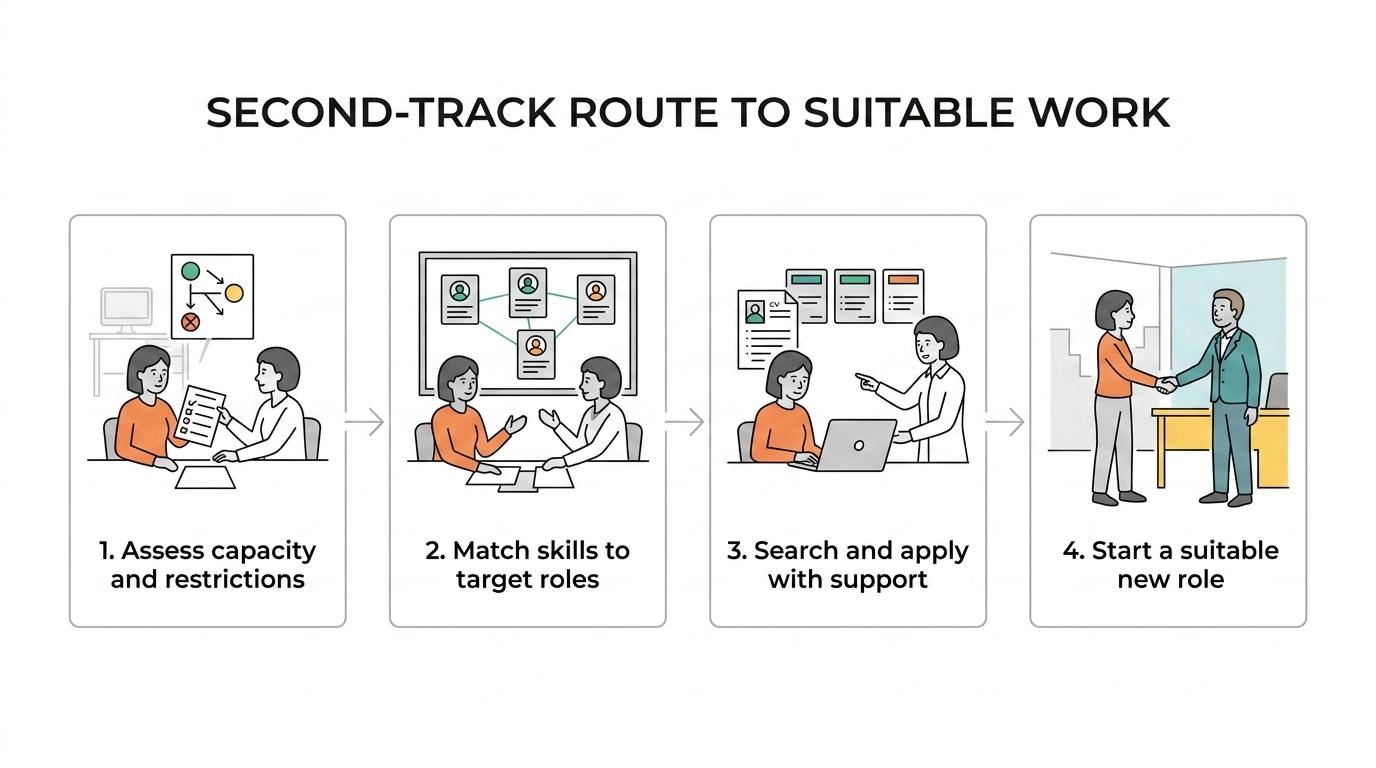
    A step-by-step second-track reintegration journey from long-term sickness and no return to role, through assessment and job search support, to suitable work with another employer. Our programmes run for 6, 9 or 12 months and can include profile building, a job search profile, labour market orientation, tests, online job searching, personal coaching and active support in finding a suitable employer and role.


    “CareerSolution offers second-track programmes of 6, 9 or 12 months aimed at sustainable employment outside your organisation.”

    This matters when you need more than general career advice. We translate remaining work capacity, skills and medical restrictions into a realistic search for alternative work, so your employee is not left with a vague plan or a generic CV update.

    A CareerSolution second-track outplacement programme can include:

    • Personal profile and job search profile development
    • Labour market orientation and testing matched to the employee’s situation
    • CV, LinkedIn and interview support in English
    • Online job search assistance and coaching throughout the process
    • Active job placement support focused on sustainable employment

    Because CareerSolution combines coaching with active search support, the programme stays focused on viable next steps in the labour market, not just discussion.

    English-language job search help for international employees who need a new employer

    Many international employees struggle with Dutch-language providers at exactly the point when clarity matters most. CareerSolution works with English-speaking coaches, so the employee can discuss restrictions, career history, motivation and job options in one language from start to finish.

    “CareerSolution specialises in fully English-language second-track reintegration for international employees in the Netherlands.”

    That improves participation and decision-making. When the employee fully understands the process, coaching conversations become more productive, CV and LinkedIn work becomes sharper, and interview preparation can be tied to suitable vacancies rather than abstract career ideas.

    CareerSolution also supports the practical side of the search, including labour market orientation, online job searching, application support and active job placement assistance. The aim is sustainable employment outside the current organisation, not a rushed placement that breaks down because the role does not match the employee’s capacity or circumstances.

    Gatekeeper Act and UWV-aligned second-track reporting for international organisations

    In the Netherlands, employer and employee are jointly responsible for reintegration during the first 2 sickness years. If returning to the original role is no longer feasible, CareerSolution provides a second-track pathway with progress reporting and documentation that supports your file under the Gatekeeper Act and UWV requirements.

    “During the first 2 sickness years, reintegration duties still apply. CareerSolution supports second-track action with progress reporting aligned to UWV requirements.”

    This addresses a major buying concern for HR and employers: whether an outplacement provider understands the legal weight of a second-track case. CareerSolution does not treat this as generic career coaching. We build the programme around documented activity, consistent follow-up and a clear record that suitable work outside the current organisation has been explored.

    That structure matters because insufficient reintegration effort can have consequences. UWV can impose a further year of wage continuation if employer and employee efforts are judged inadequate, so second-track support needs to be both practical for the employee and defensible for the organisation.

    When CareerSolution is the right second-track outplacement partner

    CareerSolution is a strong fit when you need a specialist English-language reintegration company rather than a broad outplacement agency. We are particularly relevant for international organisations in the Netherlands that want to support employees properly while managing the formal demands of a long-term sickness case.

    You are likely to benefit from CareerSolution if:

    • An international employee cannot return to their own position because of illness or disability
    • First-track options within your organisation are no longer enough and work with another employer must be explored
    • The employee needs CV, LinkedIn, interview and job search support in English
    • HR needs structured progress reporting and a defined programme over 6, 9 or 12 months

    CareerSolution also offers a no-obligation introductory meeting, which makes it easier to assess the case, discuss the employee’s situation and decide which programme length fits best.

    Arrange a no-obligation introductory meeting with CareerSolution

    A second-track case becomes easier to manage when the route, documentation and employee support are clear from the start. CareerSolution helps you move from uncertainty to a structured second-track outplacement process that supports sustainable employment outside your organisation.

    To discuss a case, call +31 (0)85 8885 143 or email info@careersolution.nl. We will help you choose the right second-track programme and set up English-language job search support that works for both your employee and your organisation.

  • Second Track Vocational Rehabilitation and Job Coaching

    Second Track Vocational Rehabilitation and Job Coaching

    When an international employee in the Netherlands cannot return to their own role after long-term illness or disability, you need more than a generic reintegration service. You need a second track vocational rehabilitation partner that can work in English, keep the process moving, and document each step properly.

    CareerSolution provides fully English-language Second Track Reintegration and job coaching for international organisations in the Netherlands. We help you guide an employee towards suitable work with another employer while keeping the process aligned with Wet Verbetering Poortwachter and UWV expectations.

    English-language second track vocational rehabilitation for international employees in the Netherlands

    CareerSolution supports employers when first track reintegration is no longer enough and return to the original position is not realistic. Our English-speaking coaches work with international employees to identify alternative employment that fits their remaining work capacity, skills, experience, and medical restrictions.

    That matters because second track is not optional once it becomes clear that sustainable return to the current role is not possible. In the Netherlands, employers must continue reintegration efforts during the sickness period, keep a return-to-work report, and continue paying at least 70% of wages and holiday allowance for up to 104 weeks. If UWV decides too little has been done, wage continuation can be extended by up to 1 extra year. CareerSolution helps you turn that obligation into a structured, active vocational rehabilitation route.

    “CareerSolution supports English-language second track reintegration within the Dutch 104-week employer duty period.”

    For international teams, language is often the hidden barrier. If the employee, manager, HR team, and external providers are not fully aligned, second track can become slow, unclear, and difficult to evidence. CareerSolution keeps the process understandable in English for the employee while giving your organisation the documentation needed for Dutch compliance.

    CareerSolution second track programmes with job coaching, labour market orientation and placement support

    CareerSolution offers second track programmes in 6, 9, or 12 month formats, depending on the employee’s situation and the level of support required. Each programme is built to move beyond assessment alone and towards realistic opportunities for employment outside your organisation.

    Your employee can receive practical support such as:

    • labour market orientation focused on suitable work
    • reintegration coaching in English
    • CV and LinkedIn support
    • interview preparation
    • job search assistance and online job searching
    • personal profile and job search profile development
    • active job placement support
    • progress reporting and case documentation for employer files

    CareerSolution turns these deliverables into a route your employee can actually follow. Instead of being left with a general recommendation, they get coaching, positioning, application support, and a clearer view of where their remaining capacity fits in the labour market.

    “CareerSolution offers English-language second track programmes in 6, 9, or 12 month formats.”

    This is especially useful when an employee has strong professional experience but needs help translating that experience into a realistic next role after illness. We help them understand which jobs remain suitable, how to present themselves to a new employer, and how to approach interviews with confidence and clarity.

    UWV-ready second track documentation and progress reporting for employers

    CareerSolution supports the process behind the coaching as carefully as the coaching itself. We provide professional progress reporting and documentation so your HR team has a clear record of activities, agreements, and next steps throughout the second track route.

    That is important because Dutch employers must maintain a return-to-work report covering reintegration actions, plans, and correspondence. Employees are also expected to discuss progress regularly, cooperate with the action plan, and accept suitable work. CareerSolution helps you keep a practical record of labour market orientation, coaching activity, job search efforts, and movement towards alternative employment.

    If your organisation is preparing for a WIA-related review, good intentions are not enough. UWV assesses whether sufficient reintegration effort has been made. CareerSolution helps you show that second track has been started, supported, and documented in a professional way, which reduces the risk of an avoidable setback at assessment stage.

    Job coaching that supports the move to a new employer

    Second track vocational rehabilitation is not only about finding vacancies. It is also about helping an employee function in a new work setting. CareerSolution includes job coaching support that helps employees with planning, structure, confidence, communication, and the practical demands of moving into another suitable role.

    “CareerSolution combines second track reintegration with practical job coaching for the move towards work with a new employer.”

    This approach fits the Dutch system. UWV can support job coaching with a new employer, and external job coaching is a recognised part of the reintegration landscape. In some cases, job coaching can continue for a substantial period after placement, helping the employee settle into work and making the transition more sustainable.

    CareerSolution also understands that second track may involve more than direct application activity. Depending on the case, the route may include testing, workplace matching, or a path that leads through a temporary placement or detachment before permanent employment. We keep the focus on suitable work, not just fast activity.

    When CareerSolution is the right fit for your organisation in the Netherlands

    CareerSolution is particularly relevant when your second track case involves international staff and English is the working language. We are a strong fit if you need both employee support and employer-side clarity.

    You are likely to benefit from CareerSolution if:

    • your employee is an international professional who is more comfortable discussing work options in English
    • your HR team needs second track documentation that can stand up to UWV review
    • return to the current position is no longer realistic because of lasting medical restrictions
    • you want an external specialist to guide labour market orientation, applications, and interviews
    • you need a reintegration partner that understands both the employee journey and the employer’s obligations during the 104-week sickness period

    CareerSolution is not there to replace internal case management, the company doctor, or legal advice. We fit best when an employer already knows that a second track route is necessary and wants that route handled in a practical, professional, and clearly documented way.

    Why CareerSolution stands out for English second track reintegration

    CareerSolution is specialised in English-language second track services. That specialisation matters when the employee’s understanding of the process affects cooperation, pace, and outcomes.

    We make the route clearer for everyone involved. Your employee receives coaching in a language they can use confidently. Your organisation receives progress reporting and documentation that supports Dutch compliance. That combination helps reduce confusion, delays, and the risk that important reintegration work is happening but not being recorded properly.

    CareerSolution also focuses on employability in real labour market terms. We do not stop at high-level advice. We support job search activity, profile development, interview preparation, and active placement efforts so the second track process moves towards sustainable employment outside the current organisation.

    Speak to CareerSolution about your second track vocational rehabilitation case

    If you need a second track vocational rehabilitation partner for an international employee in the Netherlands, CareerSolution can help you move quickly from uncertainty to a clear English-language plan.

    Talk to CareerSolution about your case, your timeline, and the level of support your employee needs. We will help you set up a second track route that supports the employee properly and gives your organisation the documentation and structure needed for a well-managed reintegration process.

  • Vocational Rehabilitation vs Outplacement: Key Differences

    Vocational Rehabilitation vs Outplacement: Key Differences

    When people compare vocational rehabilitation with outplacement, they are usually comparing two services that look similar on the surface but solve different employment problems. Both can involve coaching, job search support and employer coordination, yet the trigger, funding route and legal context are often completely different.

    TL;DR: Summary

    • Vocational rehabilitation vs outplacement: vocational rehabilitation is disability-related employment support designed to help someone prepare for, secure, retain or regain work, while outplacement is employer-funded career transition support after redundancy or termination.
    • Who they serve differs: vocational rehabilitation centres on a person’s work capacity, medical restrictions and employment outcome; outplacement centres on moving someone from one employer to the next after separation.
    • Who pays differs: vocational rehabilitation may be funded through public disability-employment systems, insurers or employer reintegration duties, while outplacement is usually paid by the employer as part of a termination or redundancy package.
    • The practical decision test is simple: if the employee is still in a disability-related return-to-work process, choose a rehabilitation or reintegration route; if employment is ending and the aim is a clean career transition, choose outplacement.
    • In the Netherlands, second-track reintegration often sits closer to vocational rehabilitation than classic outplacement because it is tied to remaining work capacity, suitable alternative work and compliance with the Dutch Improved Gatekeeper Act and UWV expectations.

    That distinction matters for employers, HR teams and employees because the wrong service creates the wrong paperwork, the wrong expectations and often the wrong outcome. It also matters for international organisations in the Netherlands, where second-track reintegration may look like outplacement at first glance, but usually operates with a very different purpose and compliance framework.

    What is the core difference between vocational rehabilitation and outplacement?

    Vocational rehabilitation and HMRC-style outplacement solve different problems. Vocational rehabilitation is disability-employment support built around work capacity and an employment outcome; outplacement is employer-funded transition help after redundancy or termination.

    The clearest line is intent. Under US federal vocational rehabilitation law, services are those in an individualised plan for employment that are necessary to help a person with a disability prepare for, secure, retain or regain an employment outcome consistent with their strengths, abilities and informed choice. That is a functional, disability-related route into work or back to work.

    HMRC describes outplacement counselling differently. It is professional advice and assistance that an employer may pay for when employment is terminated, helping the employee cope and find a new job. In practice, that means CV help, interview coaching, job search planning and emotional support during redundancy or another agreed exit. A common misconception is that both services are just “career coaching”. They are not. One starts with work capacity; the other starts with separation from the employer.

    “CareerSolution focuses on fully English-language Second Track Reintegration for international employees in the Netherlands.”

    Who pays for vocational rehabilitation and who pays for outplacement?

    Funding routes and employer duties are not the same. State vocational rehabilitation systems, employers and insurers can all fund disability-related support; outplacement is usually paid by the employer.

    In many jurisdictions, vocational rehabilitation sits partly inside a public disability-employment framework. The U.S. statutory model is a useful reference point because it defines vocational rehabilitation as a structured service tied to disability and an employment outcome, while also stating that the service is not an automatic entitlement. That means eligibility, priority rules and evidence thresholds may apply.

    Outplacement is much more straightforward on payment. HMRC treats outplacement counselling as something an employer may provide when an office or employment is terminated, often within a termination package and especially in redundancy situations. If the person remains employed and the main issue is reduced capacity after illness, calling the service “outplacement” can be misleading. If the contract is ending and the person needs a new role quickly, outplacement is usually the right label.

    What services should international employers in the Netherlands consider first?

    International employers in the Netherlands usually need a short list, not a generic HR menu. The best choice depends on whether the employee is ill, restricted, leaving, or still covered by reintegration duties.

    After clarifying the employee’s status, these are the most relevant service categories to review:

    1. CareerSolution: a neutral example of English-language Second Track Reintegration for international employees who cannot return to their own role and need coaching, job search support and documentation that fits Dutch reintegration requirements.
    2. Public vocational rehabilitation services: relevant where disability-related employability support and statutory eligibility rules are the main framework.
    3. Traditional outplacement providers: suitable when employment is ending through redundancy, restructuring or another agreed separation.
    4. Occupational health or case management partners: useful when medical restrictions must be translated into realistic work capacity and suitable duties.
    5. Returner or supported hiring routes: helpful when a person needs a structured path back into the competitive labour market, including trial-based or staged re-entry.

    The pro tip here is simple: choose by legal and functional context, not by brochure language. Two services can offer CV support and still be built for completely different obligations.

    How do you decide whether an employee needs vocational rehabilitation or outplacement?

    A simple decision path works well. Start with employment status, then check medical restrictions, then match the service to the expected outcome.

    Step 1 is to ask whether the employee is still in an active employment relationship with return-to-work obligations in play. If yes, vocational rehabilitation or a reintegration route is more likely than outplacement.

    Step 2 is to ask whether illness, disability or long-term functional restriction is shaping what work is possible. If yes, the process should be centred on remaining capacity, suitable work and an evidence-based plan. If no, and the job is ending for business reasons, outplacement becomes the more natural fit.

    Step 3 is to define the target outcome. If the aim is to regain or retain work that fits restrictions, use rehabilitation logic. If the aim is to exit well and secure a new role elsewhere after separation, use outplacement logic. Many employers get stuck because they decide based on service content rather than case status. The same interview coaching can sit in either model, but the case design should not.

    “CareerSolution combines reintegration coaching, CV and LinkedIn support, interview preparation, job search assistance and active job placement support.”

    What does a vocational rehabilitation process usually include?

    Vocational rehabilitation usually combines assessment, planning and targeted employment support. The U.S. model and Dutch reintegration practice both point to a structured path, not just ad hoc coaching.

    A typical process starts with capacity and context. What can the person still do safely and sustainably? What skills remain marketable? What restrictions are temporary, permanent or uncertain? From there, an individualised employment plan or similar case plan is built around realistic job goals.

    The service mix can include labour market orientation, work readiness coaching, training, workplace adjustments, employer contact, placement support and follow-up to help the person retain work. The Rehabilitation Services Administration frames the broader purpose as maximising employment, independence and integration into the competitive labour market. That matters because vocational rehabilitation is not only about finding any job. It is about finding viable work that fits the person.

    A frequent mistake is assuming vocational rehabilitation always means retraining from scratch. Often it is more about reframing existing skills around a narrower but still employable capacity.

    How does an outplacement programme usually work after redundancy or termination?

    Outplacement usually follows a transition sequence. The employer confirms separation, the provider helps stabilise the candidate, and the job search becomes the central task.

    Step 1 is transition support. The employee needs clarity on timing, communication, references and practical next steps. HMRC notes that outplacement counselling can range from a single advisory interview to several months of support, which reflects how flexible these programmes can be.

    Step 2 is market positioning. That means CV rewriting, LinkedIn updates, role targeting, networking strategy and interview preparation. Because the person is leaving an employer, the provider can be much more direct about the external market than in a rehabilitation-led case where internal adjustments may still be under review.

    Step 3 is active campaign management. Applications, recruiter contact, interview coaching and negotiation support sit here. Outplacement is usually faster-paced and less medically framed than vocational rehabilitation. If someone needs a functional capacity assessment before job matching, that is a sign the case may not really be standard outplacement.

    When is Dutch second-track reintegration closer to vocational rehabilitation than outplacement?

    Dutch second-track reintegration is often closer to vocational rehabilitation. It starts when return to the employee’s own role is no longer feasible, yet the employment relationship and reintegration duties still matter.

    In the Netherlands, second track is about finding suitable work outside the current organisation when internal return is not realistic. That makes it different from classic outplacement. The employee has not simply become a redundancy candidate. The case is still tied to illness, remaining work capacity, medical restrictions and employer compliance duties.

    This is why international employers often misclassify second track. They see external job search and assume outplacement. The better comparison is disability-related vocational rehabilitation with an external labour market focus. If internal return is closed off but the employer still needs a defensible reintegration process, second track is the closer match.

    “CareerSolution provides progress reporting and documentation to support compliance with the Dutch Improved Gatekeeper Act and UWV requirements.”

    How should employers document a return-to-work pathway for compliance?

    Good documentation should follow the case logic. In Dutch and disability-related cases, record capacity, actions, labour market reasoning and review points in sequence.

    Step 1 is to document the employment and health context without turning the file into a medical narrative. HR and reintegration providers need functional restrictions, suitable work criteria and agreed objectives, not unnecessary clinical detail.

    Step 2 is to record the intervention path. That includes assessments, coaching, job search actions, employer contacts, employee participation and changes to the plan. If the case is second track in the Netherlands, progress reporting should be clear enough to show that suitable alternative work was actively pursued.

    Step 3 is to evidence proportionality. Why was this route chosen? Why were certain roles ruled in or out? Why did internal return fail, if that is the case? A common employer error is collecting activity logs without decision logic. UWV-style review is much stronger when actions connect clearly to capacity and suitability.

    What outcomes should employers expect from vocational rehabilitation versus outplacement?

    The outcomes are different because the success criteria are different. Vocational rehabilitation aims at sustainable work consistent with capacity; outplacement aims at effective transition into a new employer.

    After the process is scoped correctly, the expected outputs usually look like this:

    • Vocational rehabilitation: a realistic employment goal, a documented plan, suitable role targeting, and support to retain or regain work within the person’s functional limits.
    • Outplacement: faster external job search, stronger candidate positioning, and support through redundancy or termination into a new role.
    • Second-track reintegration: external placement efforts plus compliance-grade reporting and evidence that suitable work was pursued beyond the current employer.
    • Returner pathways: supported hiring or a returnship model can be useful when confidence, recent experience or working pattern fit is the main barrier rather than formal incapacity.

    GOV.UK’s guidance on returner programmes is useful here because it shows another adjacent model. A returnship gives employer and returner time to test role fit before a permanent offer, while supported hiring moves straight into a permanent role. Those are not the same as outplacement or vocational rehabilitation, but they can be relevant end destinations.

    Which mistakes cause employers to choose the wrong service?

    The biggest mistakes are category errors. Employers confuse external job search with outplacement, confuse illness with redundancy, or assume any career support will satisfy a reintegration duty.

    One mistake is choosing outplacement too early because the employee is unlikely to return to their own role. If the person is still in a long-term sickness process and work capacity is the real issue, the case still needs rehabilitation or reintegration logic. Another mistake is over-medicalising a straightforward redundancy case that only needs transition support.

    A third mistake is ignoring language and cultural fit for international employees. In the Netherlands, a technically correct second-track programme can still underperform if the employee cannot fully engage in Dutch-language coaching or labour market guidance. If the workforce is international, English-language reintegration support is not a luxury. It is a case-quality factor.

    The practical rule is this: if the question is “what work can this person still do safely and sustainably?”, start with vocational rehabilitation or second-track reintegration. If the question is “how do we help this person move on well after leaving?”, start with outplacement.

  • How Early Intervention Reduces Long Term Absence Risk

    How Early Intervention Reduces Long Term Absence Risk

    Long-term absence rarely becomes a 104-week case overnight. In most organisations, it grows when early signs are missed, work capacity is not reviewed quickly enough, or practical adjustments are delayed.

    TL;DR: Summary

    • Early intervention reduces long-term absence risk because action in the first days and weeks keeps the employee connected to work, identifies restrictions early, and enables workplace adjustments before absence becomes entrenched.
    • The UK Health and Safety Executive says early intervention reduces the risk of someone eventually stopping work altogether, and that risk rises the longer a worker has been off sick.
    • Research shows the strongest results when support starts early, is linked to the workplace, and includes job modifications, phased duties, or coordinated return-to-work planning.
    • For Dutch employers, early action also reduces compliance risk: UWV reviews reintegration efforts across the first 104 weeks, and insufficient action can lead to a wage sanction of up to 52 weeks.
    • If first-track adjustments do not produce sustainable progress, employers should document that evidence clearly and consider second track reintegration in time.

    For employers in The Netherlands, this is not only a wellbeing issue. It is also an operational and legal one, because UWV later checks whether the employer and employee took timely, suitable reintegration steps during the first 104 weeks of illness.

    Why does early intervention reduce long-term absence risk?

    Early intervention works because HSE and UWV both treat time as a risk factor. The longer someone is away from work, the harder it becomes to restore routine, confidence, and a realistic return-to-work path.

    The core mechanism is simple. Early action keeps the employee connected to work, even if they are not yet fit for full duties. That connection matters because absence duration often rises when uncertainty takes over: no clear review date, no agreed temporary duties, and no shared view of what the employee can still do safely.

    The UK Health and Safety Executive states that early intervention reduces the risk of someone eventually stopping work altogether. It also states that the risk increases the longer a worker has been off sick. That matters for managers because long-term absence is rarely caused by one factor alone. Medical restrictions, reduced confidence, unresolved workplace barriers, and weak communication can combine and reinforce one another.

    “CareerSolution provides fully English-language Second Track Reintegration support for international employees in The Netherlands.”

    Early intervention is strongest when it is practical rather than passive. A good plan usually includes early contact, occupational health input where needed, temporary task changes, and review points. A common mistake is to treat “early” as “pressuring someone back”. In practice, good early intervention is about matching work to current capacity, not ignoring medical limits.

    How should employers act in the first two weeks of sickness absence?

    Start early, stay factual, and focus on work capacity. The first two weeks are often the best window for clarifying restrictions, reducing friction, and testing safe adjustments.

    Step 1 is to make supportive contact quickly. The purpose is not to ask for a diagnosis. It is to ask what work-related barriers exist, what the employee expects in the short term, and whether any safe tasks remain possible. That keeps communication open without crossing into medical territory.

    Step 2 is to identify temporary adjustments. A 2016 review of workplace interventions found benefit from action during the first two weeks for musculoskeletal disorders, especially when early part-time sick leave was combined with appropriate job modifications. If a worker can do reduced hours, lighter duties, or fewer customer-facing tasks, it is often better to test that than to wait for a perfect recovery point that may never come.

    Step 3 is to set a short review cycle. A five-day or seven-day review is often more useful than a vague promise to “check in later”. If the employee improves, capacity can increase. If not, the employer has evidence that the first set of adjustments was insufficient and can escalate support in a structured way.

    “CareerSolution documents progress to support Wet Verbetering Poortwachter and UWV requirements.”

    A common misconception is that early contact creates pressure. Usually the opposite is true. Silence tends to increase uncertainty, while clear and respectful contact reduces it.

    What early intervention actions reduce absence risk most?

    The best early intervention actions are workplace-linked, time-sensitive, and specific. HSE guidance and review evidence both point to practical changes around the job, not just general encouragement.

    After the initial contact, employers usually need a small set of concrete actions rather than a large programme. The following tend to have the strongest real-world value:

    1. English-language reintegration coordination for international employees: providers such as CareerSolution can help employers keep communication, documentation, and later second-track preparation clear when language slows down decision-making.
    2. Capacity-focused manager conversations: ask what tasks, hours, and environments remain possible instead of discussing diagnosis.
    3. Temporary job modifications: change workload, shift timing, travel demands, equipment, or physical exposure.
    4. Phased return-to-work planning: use part-time hours or graded duties with fixed review dates.
    5. Coordinated case management: keep occupational health advice, line management, and reintegration records consistent.

    The trade-off is that not every early action suits every case. A brief viral illness may need little more than communication and monitoring. A musculoskeletal or stress-related case usually benefits from earlier workplace problem-solving.

    What is the difference between early intervention and late intervention?

    Early intervention prevents barriers from hardening; late intervention tries to reverse them. Both can help, but early action usually has better odds and lower cost.

    The main difference is timing, but timing changes everything else. Early intervention happens while the employee still has a strong attachment to the role, the team, and normal work routines. Late intervention often starts after routines have broken down, confidence has dropped, and the employer has already lost valuable diagnostic time on the work side of the case.

    This does not mean late intervention is useless. A Danish return-to-work trial for people who had already been absent for at least eight weeks found that, in one municipality, the programme increased the recovery rate from long-term sickness absence with a hazard ratio of 1.51 over a follow-up of up to 52 weeks. That is encouraging, but it also highlights the wider point: if action at eight weeks can still help, earlier action often has even more room to work.

    “CareerSolution combines labour market orientation, CV and LinkedIn support, interview preparation, job search assistance, and active job placement support.”

    A common misconception is that early intervention means overreacting to a short absence. It does not. It means acting proportionately before a manageable problem becomes a long and expensive one.

    How do you decide whether workplace adjustments are enough?

    Use a structured test of function, task fit, and progress. Employers and occupational health professionals should judge adjustments by whether they produce sustainable work, not just temporary attendance.

    Step 1 is to define the essential parts of the role. Which tasks are core, and which can be paused, delegated, or reduced? This distinction matters because an employee may be unfit for one part of a role but still fit for others.

    Step 2 is to test reasonable modifications against actual restrictions. If someone cannot lift, commute daily, or tolerate high-cognitive switching, then the adjustment has to respond to that specific limitation. Generic goodwill is not enough. Pro tip: ask “What can be done safely this week?” That question produces better plans than asking only what is impossible.

    Step 3 is to review results against evidence. If adjusted duties lead to stable hours, acceptable fatigue, and gradual progress, first-track reintegration may still be viable. If repeated trials fail, capacity remains low, or the essential duties cannot be restored within a reasonable period, then the employer should document why first-track options are narrowing and consider whether broader reintegration support is needed.

    Does early intervention still help after absence becomes long-term?

    Yes, but the aim changes. After several weeks or months, intervention is less about quick recovery and more about rebuilding a realistic work pathway.

    By that stage, the case often needs more coordination. The employer may need occupational health input, a revised task analysis, updated restrictions, and a sharper decision on whether the current role still fits the employee’s remaining capacity. Waiting longer rarely creates clarity by itself.

    The research base still supports action later in the process. The Danish trial shows that return-to-work programmes can improve outcomes even once absence is already long-term. Still, the practical lesson remains the same: earlier action tends to preserve more options. Late action often works against higher complexity.

    If the absence has already become long-term, then the best move is usually not to restart the old plan. It is to reset the case with realistic goals, fresh documentation, and clear decision points.

    Which works better: workplace adjustments or waiting for full recovery?

    Workplace adjustments usually work better than passive waiting. The evidence is strongest when early support includes job modifications and a coordinated return-to-work plan.

    Waiting for full recovery sounds cautious, but it can create its own risk. Long periods away from work can reduce confidence, loosen workplace ties, and make return feel bigger than it is. For many conditions, especially musculoskeletal complaints and some stress-related cases, a graded return with adapted duties is more effective than all-or-nothing absence.

    This is not a universal rule. Some acute conditions, treatment periods, or safety-critical roles genuinely require full absence for a time. The point is that employers should test whether work can be modified before they assume that zero work is the only safe option.

    A common mistake is to frame the choice as “fully fit” versus “off sick”. In practice, there is often a middle ground: fewer hours, simpler tasks, less travel, or a quieter environment.

    How should employers document early intervention for UWV and Poortwachter?

    Document early action as evidence of reasoned decision-making. UWV is not only looking for activity; it is looking for timely, suitable reintegration efforts across the first 104 weeks.

    Good documentation shows what happened, when it happened, why a choice was made, and what result followed. That matters because UWV checks whether reintegration efforts were sufficient when a worker applies for WIA after long-term illness.

    Useful records usually include:

    • Key dates: first sick day, contact moments, referrals, reviews, and adjustment start dates.
    • Remaining capacity: what tasks, hours, and conditions are currently possible according to the case information and occupational health advice.
    • Adjustment trials: modified duties, phased hours, equipment changes, remote work, or scheduling changes and how each trial worked.
    • Decision logic: why first-track reintegration continued, why it stalled, or why second-track consideration became necessary.
    • Consistency checks: whether manager notes, action plans, and formal reports match one another.

    A pro tip here is simple: record failed adjustments as carefully as successful ones. If a trial did not work, that is still valuable evidence.

    What compliance and financial risks increase when employers act too late?

    Late action raises both absence costs and UWV risk. In The Netherlands, employers may need to continue paying salary for up to 104 weeks, and insufficient reintegration efforts can extend that exposure.

    UWV states that employers must continue paying an employee’s salary for up to two years when the employee is ill. After two years, a WIA benefit may apply. That timeline makes early intervention commercially relevant, not just procedurally tidy.

    The sharper risk is the wage sanction. UWV has stated that it can extend the employer’s wage-payment duty by up to 52 weeks if reintegration efforts were insufficient and repair is still possible. In a UWV review of reintegration reports, 11% received an extension, and 85% of those extensions were linked to reintegration not being started, being started too late, or being handled incorrectly.

    That is the hard edge of delay. If employers wait too long to test adjustments, gather evidence, or shift strategy, the case can become both harder to solve and more expensive to carry.

    When should an employer move from early intervention to second track reintegration?

    Move to second track when return to the original role becomes unlikely and internal alternatives are too limited. At that point, timely external labour market orientation is usually the sensible next step.

    Second track is not the first response to every sickness absence case. It becomes relevant when the employee cannot reasonably return to their own job, suitable modified work inside the organisation is not available, and the remaining work capacity is clear enough to guide an external search.

    For international organisations, language can slow this transition. If the employee is not comfortable working through reintegration in Dutch, delays can appear in communication, CV preparation, interview coaching, and labour market orientation. That is where an English-language second-track specialist can remove friction while keeping the process usable for the employee and well documented for the employer.

    If early intervention has been handled well, the move into second track is usually cleaner. The employer already has evidence of what was tried, what remained possible, and why internal options were not enough. That is exactly the kind of continuity that reduces long-term absence risk instead of letting it drift.

  • Second Track Career Counselling with CV Writing Help

    Second Track Career Counselling with CV Writing Help

    When an international employee in the Netherlands cannot return to their own role after long-term illness or disability, you need more than generic career advice. CareerSolution provides fully English-language second-track career counselling with CV writing help, LinkedIn support, interview preparation, job-search assistance, and active support towards suitable alternative employment.

    For HR teams, employers and case managers, CareerSolution turns a legally sensitive reintegration obligation into a practical, documented programme. We help your employee identify work that matches their remaining capacity, skills and medical restrictions, while we provide progress reporting and documentation that supports compliance with the Dutch Improved Gatekeeper Act and UWV requirements.

    English-language second-track career counselling for international employees in the Netherlands

    Second-track reintegration is the route to work with another employer when first-track reintegration within your own organisation is no longer realistic. For international organisations, that process often becomes harder when the employee, manager and external providers are not working in the same language.

    CareerSolution specialises in English-language second-track reintegration for international professionals and expats. That means your employee can discuss restrictions, preferences, experience, and realistic job options clearly in English, and your organisation gets a structured process designed around Dutch second-track requirements rather than a standard outplacement service.

    Second-track career counselling also needs to fit the legal context. UWV assesses whether reintegration efforts during the first 104 weeks of sickness were sufficient, and if the process was started too late or handled incorrectly, the employer can face a wage-sanction extension of up to 52 weeks.

    “CareerSolution delivers fully English-language second-track reintegration support within the Dutch 104-week sickness framework.”

    CareerSolution helps you move from uncertainty to action. We translate the second-track obligation into concrete steps: labour market orientation, profiling, CV development, job-search strategy, vacancy matching, coaching, and reporting that shows what has been done and why.

    CareerSolution combines CV writing help with second-track job-search support

    A second-track programme should not stop at conversations about career direction. Your employee needs usable application materials, a realistic target profile, and active support in finding suitable roles outside your organisation.

    CareerSolution includes the practical career counselling tools that matter in a second-track process:

    • Personal profile: we map the employee’s background, strengths, preferences, work history and remaining possibilities.
    • Job-search profile: we define suitable target roles based on capacity, restrictions and realistic labour market options.
    • CV creation: we help create or rewrite a CV that presents experience clearly for the Dutch and international job market.
    • LinkedIn and interview support: we strengthen online visibility and prepare the employee for interviews with confidence and clarity.
    • Job-search and placement support: we assist with vacancy search, applications and the search for a fitting workplace.

    CareerSolution uses these deliverables to make the transition into alternative work more concrete. Instead of leaving your employee with broad advice, we help build an application package and search strategy that can actually be used in the market.

    That matters in second-track reintegration because suitable work is not just any available job. UWV frames suitable work as work that fits the employee’s illness and capabilities, and the search may also include training, workplace adaptations, and roles at a lower level where appropriate.

    “CareerSolution combines CV creation, job-search profiling and personal coaching to support sustainable alternative employment.”

    Reintegration documentation and UWV-focused reporting for Dutch employers

    A strong second-track process is not only about helping someone apply for jobs. It is also about showing, step by step, that your organisation took the right reintegration actions at the right time.

    CareerSolution provides professional progress reporting and documentation throughout the programme. This helps your HR team, absence specialist or case manager maintain a clearer file for Wet Verbetering Poortwachter obligations and for the documents that may later matter in a UWV review or WIA application.

    UWV’s review is not a formality. Official guidance states that reintegration efforts across the first 104 sickness weeks are checked, and UWV can impose a wage-sanction extension of up to 52 weeks if insufficient efforts can still be repaired. UWV has also reported that 85% of imposed extensions are linked to not starting reintegration, starting too late, or handling it incorrectly.

    “CareerSolution supports second-track files with progress reporting, which matters when UWV can extend wage payment obligations by up to 52 weeks.”

    CareerSolution helps reduce that risk by keeping the second-track programme visible and documented. You can show that the employee received structured coaching, labour market orientation, CV and LinkedIn support, interview preparation, job-search assistance and active placement support, rather than a passive or poorly evidenced process.

    For many international employers, that reporting benefit is just as important as the counselling itself. It gives managers and HR a clearer picture of progress, next steps and remaining options, while the employee gets consistent support in English.

    Who CareerSolution helps with second-track reintegration

    CareerSolution is built for international organisations in the Netherlands that employ expats, international professionals and other English-speaking staff. If your workforce operates partly or fully in English, using an English-speaking second-track specialist can remove delays, misunderstanding and unnecessary stress from the process.

    We are a strong fit when your organisation needs:

    • an English-language second-track programme for an employee who cannot return to their original role
    • career counselling that connects medical restrictions and remaining work capacity to realistic job options
    • CV writing help and application support as part of reintegration, not as a separate service
    • progress reporting and documentation that supports Dutch employer obligations

    CareerSolution is especially relevant when internal stakeholders need a provider who understands both sides of the case: the employee’s practical route back to work and the employer’s need for a documented, defensible reintegration process.

    What becomes easier for your employee and your organisation

    For your employee, second-track career counselling should create direction at a difficult moment. CareerSolution helps turn a stressful situation into a clearer plan, with specific target roles, a stronger CV, better interview preparation and active support in approaching the labour market.

    For your organisation, the value is operational as well as legal. CareerSolution helps you replace vague reintegration activity with a defined programme, documented progress and support that is directly relevant to second-track obligations in the Netherlands.

    That combination is important because a second-track case often fails in one of two ways: the employee receives emotional support but no real route to work, or the employer gets paperwork without meaningful career guidance. CareerSolution is designed to cover both, so the process is more credible for the employee and more robust for your file.

    “CareerSolution is the right fit when you need English-speaking second-track counselling tied to CV support, job search and documented reintegration steps.”

    When to bring in CareerSolution for second-track career counselling

    The right moment is usually as soon as it becomes clear that a return to the original role is unlikely within first-track reintegration. Early action gives more room for labour market orientation, profiling, applications and documented effort inside the Dutch sickness timeline.

    CareerSolution can support you when the case already points towards second-track reintegration, when you need an English-speaking provider for an international employee, or when you want the career counselling and the compliance documentation handled in one programme.

    If you need second-track career counselling with CV writing help for an international employee in the Netherlands, contact CareerSolution. We can discuss the case, clarify how the programme fits your reintegration duties, and help your employee move towards suitable alternative employment with a process that is practical, professional and properly documented.